
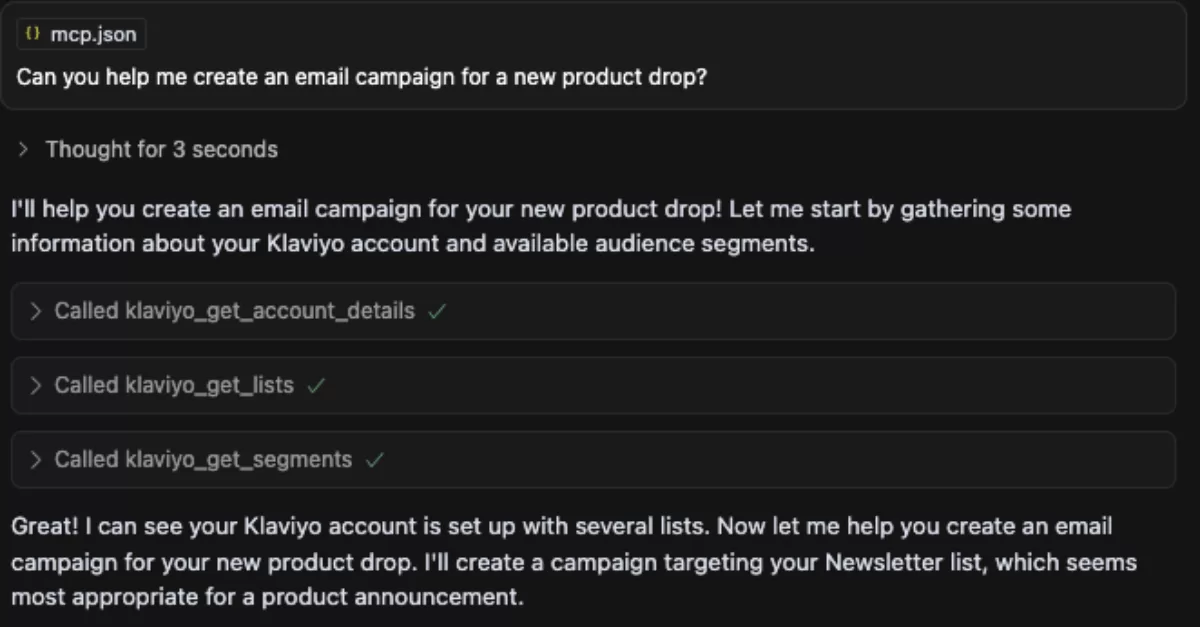
The conversation around AI in marketing has largely focused on model capabilities — better generators, smarter copilots, more advanced natural-language interfaces. But behind every “intelligent” AI interaction is one non-negotiable requirement: structured, accessible data.
That’s why Klaviyo’s recent announcement of its MCP Server (Model Context Protocol Server) is so significant. It doesn’t just add another feature to an ESP. It signals a broader shift in how marketers will interact with their data — and how AI-driven workflows will become embedded in everyday campaign operations.
What Is the Klaviyo MCP Server?
Klaviyo’s MCP Server (currently in beta) enables marketing teams to connect their Klaviyo data to AI agents and tools — using the open Model Context Protocol. Instead of manually calling Klaviyo’s traditional REST APIs, teams can now use AI tools (e.g., Claude Desktop, Cursor, VS Code extensions) to query, analyze, and act on Klaviyo data through natural-language prompts.
In practice, this means a marketer could ask:
“Show me the click-through rate for my last five campaigns.”
or:
“Draft a win-back email for customers who haven’t opened in the last 60 days — with a 15% offer.”
The MCP Server returns the relevant data — structured and formatted — so the AI agent can handle the prompt, draft the output, or take action.
This isn’t just an API shortcut. It’s a major step toward AI-native marketing operations, where the human → data → insight → execution loop happens in a single interface.
Why the Klaviyo MCP Server Matters for Publishers & Media Brands
Most publishers and media companies already use marketing automation platforms like Klaviyo to send newsletters, editorial alerts, and sponsored campaign messages. But the real revenue opportunity lies in how fast those teams can interpret engagement data and adapt campaigns in real time.
Today, that process still requires:
- Pulling reports manually
- Exporting / querying data in separate tools
- Translating insights into new campaign logic
- Building new flows by hand
By exposing Klaviyo’s campaign, flow, and audience data through MCP, marketing teams can skip the manual steps and get to intelligent action faster.
Three Business-Level Impacts
| Area | Traditional Workflow | With MCP Server |
|---|---|---|
| Campaign Optimization | Pull/export data → interpret → update targeting | “Which campaigns are underperforming?” → AI identifies issues + suggests improvements |
| Audience Segmentation | Manually build segments using filters | “Create a segment of users who clicked editorial promos 3+ times in the last 14 days” |
| Sponsored Revenue | Teams manually match ad buyers with high-intent audiences | “Show me publishers with the highest CTR in the last 7 days for sponsored content” |
In a world where editorial engagement and advertising revenue are tightly linked, the ability to make these decisions quickly — and accurately — can drive real revenue lift.
How It Works with Existing AI Tools
To use the Klaviyo MCP Server, teams authenticate via an MCP client (like the uvx CLI or an agent-aware IDE such as Cursor). Once authenticated, they can query structured Klaviyo data in real time.
Current Supported Data Types in Beta
- Campaigns
- Flows
- Segments
- Metrics (e.g. clicks, opens)
Note: The current beta is read-only, which means teams can generate insights and content, but cannot yet push changes back into Klaviyo through MCP (e.g. activating a flow). That write functionality is expected in future phases.
MCP vs. Traditional ESP Integrations
| Category | Traditional API Integration | MCP Server |
|---|---|---|
| Setup | Requires developers / API integration | AI agent + authentication |
| Focus | Data retrieval or update via code | Real-time insight + generation via natural language |
| Users | Developers / technical teams | Marketers & non-technical users |
| Time to Value | Days/weeks | Minutes |
The benefit isn’t just speed — it’s accessibility. Editors, campaign managers, and brand leads can now explore data in natural language terms, without needing SQL or Python.
Future Outlook: ESP-Agnostic, AI-Native Ecosystems
While Klaviyo’s MCP Server is one of the first in-market implementations, it’s unlikely to remain the only one. The broader trend is clear:
Model Context Protocols will become the default way LLMs access application data.
That means ESPs, CDPs, CRMs, and AdTech tools will need to expose MCP-compatible endpoints in order to stay relevant in an AI-first landscape.
For publishers and media companies, this also means rethinking how internal data infrastructure supports AI access — governance, schema consistency, and access control become strategic priorities.
Final Thoughts
Klaviyo’s MCP Server is more than a beta feature — it’s an early signal of how AI will transform marketing operations over the next 12–24 months.
By shifting from manual API calls to context-aware, AI-driven data access, marketing teams will move faster, make smarter decisions, and unlock new revenue opportunities at the intersection of editorial engagement and advertising performance.
Looking to understand how the Klaviyo MCP Server can be integrated seamlessly with your company’s AI tools?
Let’s talk — we help publishers and media brands operationalize MCPs (including Klaviyo) and connect them to their broader AI and data infrastructures.
Talk to a Klaviyo Expert
Find out how you can quickly and efficiently gain insights from real Klaviyo data — directly in your current AI toolkit.
Talk to a Klaviyo Expert
Find out how you can quickly and efficiently gain insights from real Klaviyo data — directly in your current AI toolkit.